
International Conference on Intelligent Technologies and Hydrocene: Achieving SDG 6 for Sustainable Water and Sanitation
Organized by Learners’ University & Indian Internet Observatory (IIO)
In association with CRC Press, Taylor & Francis Group — Selected Papers
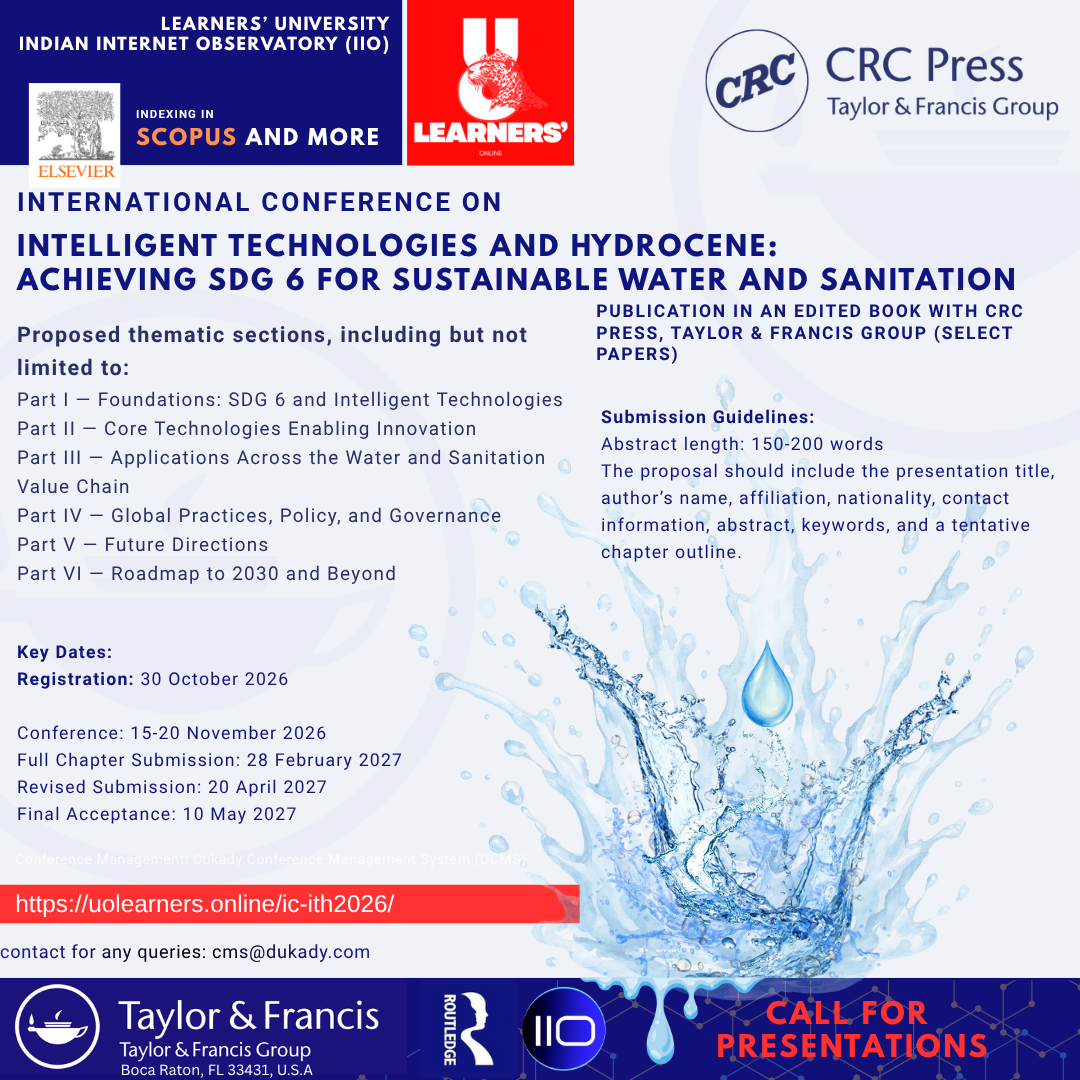
The International Conference on Intelligent Technologies and Hydrocene: Achieving SDG 6 for Sustainable Water and Sanitation brings together researchers, academics, policymakers, technology practitioners, environmental humanities scholars, water professionals, civil society organizations, and interdisciplinary researchers to critically examine how emerging technologies can contribute to the achievement of Sustainable Development Goal 6 (SDG 6): Clean Water and Sanitation for All.
The conference approaches water and sanitation not merely as technological or infrastructural challenges, but as social, cultural, ecological, political, ethical, and human challenges. It seeks to explore how artificial intelligence, machine learning, the Internet of Things, big data, remote sensing, GIS, robotics, automation, blockchain, and other intelligent technologies are transforming contemporary water systems and reshaping relationships between humans, technology, and the more-than-human environment.
The concept of the Hydrocene provides an interdisciplinary conceptual framework for examining changing relationships with water in an era characterized by technological transformation, environmental uncertainty, climate change, urbanization, resource pressures, and rapidly evolving digital infrastructures.
The conference particularly welcomes contributions that bring together technology, environmental humanities, sustainability, water studies, digital humanities, governance, policy, ethics, and social justice.
Call for Proposals
We invite chapter proposals, conceptual papers, empirical studies, case studies, policy analyses, interdisciplinary research, and critical theoretical contributions addressing intelligent technologies, sustainable water management, sanitation, and SDG 6.
Contributors are encouraged to move beyond purely technical approaches and critically examine questions of:
- Sustainability and environmental responsibility
- Technological ethics and accountability
- Water justice and equity
- Human–water relationships
- Hydrosocial systems
- Indigenous and local knowledge
- Cultural understandings of water
- Environmental humanities
- Digital inequalities and technological access
- Governance and policy
- Climate resilience
- Ecological impacts of intelligent technologies
- Just and equitable water futures
Registration Link: https://forms.gle/CRfjZeBBtbjq6qxU6
Registration Due: 30 October (Early-Bird Registration: 20 October)
For review, queries contact: cms@dukady.com and CC to research.abirlal@gmail.com
Conference Website: https://uolearners.online/ic-ith2026/
Proposed Thematic Sections and Chapters
The following themes are indicative rather than exhaustive. Proposals addressing related or emerging topics within the broader scope of intelligent technologies, water, sanitation, sustainability, and SDG 6 are strongly encouraged.
Part I — Foundations: SDG 6 and Intelligent Technologies
1. Understanding SDG 6: Global Challenges, Opportunities, and Emerging Philosophies through Environmental Humanities Perspectives
This theme invites critical and interdisciplinary examinations of SDG 6, focusing on the cultural, philosophical, ecological, historical, and social dimensions of water and sanitation. Contributions may explore changing human relationships with water, environmental ethics, water cultures, sustainability philosophies, and the role of environmental humanities in rethinking global water challenges.
2. Intelligent Technologies Transforming the Water Sector: Cultural, Ecological, and Human-Centred Considerations
This theme examines the transformation of water systems through intelligent technologies while foregrounding their human, cultural, ecological, and ethical dimensions. Contributions may critically investigate whether technological innovation genuinely produces sustainable water futures and how technology reshapes relationships among communities, institutions, ecosystems, and water resources.
Part II — Core Technologies Enabling Innovation
1. Artificial Intelligence and Machine Learning for Water Management: Ethical, Cultural, and Ecological Dimensions
Potential contributions may examine AI-driven water forecasting, demand prediction, leak detection, resource allocation, water quality prediction, and decision-support systems while addressing algorithmic accountability, bias, transparency, environmental costs, and digital inequalities.
2. IoT and Sensor Networks for Real-Time Monitoring within Human–Water Ecologies
This theme explores connected sensors, smart meters, IoT infrastructures, distributed monitoring systems, and real-time water data. Contributions may investigate how sensor-based infrastructures transform water knowledge, community participation, governance, and relationships between technological and ecological systems.
3. Big Data Analytics and Cloud Platforms: Rethinking Water Knowledge Systems
This section invites research on large-scale water datasets, cloud computing, predictive analytics, digital twins, data visualization, and data-driven decision-making. Particular attention may be given to data ownership, accessibility, interoperability, epistemic inequality, privacy, and the politics of water data.
4. Remote Sensing and GIS for Water and Sanitation Planning through Environmental Humanities Lenses
Contributions may explore satellite imagery, geospatial technologies, Earth observation, GIS-based planning, watershed mapping, disaster management, sanitation mapping, and climate monitoring while critically examining how digital representations of landscapes influence environmental decision-making and policy.
Part III — Applications Across the Water and Sanitation Value Chain
1. Smart Drinking Water Supply Systems: Hydrocene and the Transformation of Worldviews and Water Cultures
This theme explores smart water supply infrastructures and their implications for how societies understand, value, distribute, and govern drinking water. Contributions may address smart cities, intelligent distribution networks, digital water utilities, water cultures, and changing human–water relationships.
2. Technology-Enabled Sustainable Sanitation Systems and Human–Environment Relations
This section focuses on intelligent sanitation technologies, decentralized sanitation systems, wastewater treatment, resource recovery, fecal sludge management, circular sanitation, and digitally enabled sanitation services. Contributions may critically examine the social, cultural, ecological, and ethical dimensions of technological sanitation interventions.
3. Intelligent Water Quality Monitoring and Pollution Control: Social, Cultural, and Ecological Implications
Potential contributions may investigate AI-enabled water quality monitoring, sensor-based pollution detection, predictive modelling, contamination management, wastewater analytics, and early-warning systems, alongside their implications for environmental justice, public health, communities, and ecosystems.
4. Smart Irrigation and Agricultural Water Efficiency in Changing Hydrosocial Landscapes
This theme addresses precision irrigation, AI-supported agriculture, smart farming, soil and moisture sensing, water-use optimization, agricultural technologies, and climate-resilient water management. Contributions are encouraged to examine how technological interventions affect farmers, rural communities, ecosystems, and existing hydrosocial relationships.
Part IV — Global Practices, Policy, and Governance
1. Case Studies from the Global South and Global North: Hydrosocial Perspectives and Environmental Humanities Insights
Comparative and place-based case studies are particularly welcome under this theme. Contributions may examine intelligent water systems across different geographical, economic, cultural, and political contexts, with particular attention to inequalities between and within the Global South and Global North.
2. Policy, Governance, and Regulatory Frameworks for Digital Water Systems: Emerging Policies and Possibilities in the Hydrocene
This theme examines the policy and regulatory challenges associated with digital transformation in the water sector. Topics may include data governance, AI regulation, digital water policy, cybersecurity, privacy, institutional accountability, transboundary water governance, public–private partnerships, and emerging regulatory frameworks.
Part V — Future Directions
1. Financing and Scaling Intelligent Water Technologies with Just and Equitable Water Futures
This section explores the economic and institutional dimensions of scaling intelligent water technologies. Contributions may examine financing models, public investment, international development funding, innovation ecosystems, affordability, technological accessibility, and the relationship between technological scalability and water justice.
2. Emerging Innovations: Robotics, Automation, and Blockchain in Socio-Ecological Water Systems
Contributions may investigate emerging technologies including autonomous systems, robotics, blockchain-based water governance, smart contracts, automated infrastructure, digital twins, and other innovations. Critical perspectives on their opportunities, limitations, risks, and socio-ecological consequences are encouraged.
3. Roadmap to 2030 and Beyond: Integrating Technology, Culture, and Environmental Humanities
This theme invites forward-looking research on how technological innovation can be integrated with sustainability, cultural knowledge, environmental ethics, governance, and social justice to accelerate progress toward SDG 6.
Part VI — Roadmap to 2030 and Beyond
The final section will consider interdisciplinary pathways for integrating technology, sustainability, culture, governance, and environmental humanities toward the achievement of SDG 6 and the development of resilient, inclusive, and equitable water futures.
Contributions may explore long-term scenarios, emerging research agendas, policy pathways, institutional transformation, technological responsibility, climate resilience, water justice, and new interdisciplinary frameworks for understanding water in the Hydrocene.
Who Should Submit?
We welcome proposals from:
- University faculty and researchers
- Doctoral and postgraduate researchers
- Water and sanitation professionals
- Environmental humanities scholars
- Engineers and technology researchers
- AI and data science researchers
- GIS and remote-sensing specialists
- Policymakers and government officials
- Development practitioners
- Sustainability professionals
- NGOs and civil society organizations
- Urban planners and environmental practitioners
- Indigenous and local knowledge researchers
- Interdisciplinary scholars working on water, technology, and sustainability
Interdisciplinary and cross-sectoral collaborations are particularly encouraged.
Suggested Research Areas
Proposals may address, but are not limited to:
Artificial Intelligence • Machine Learning • Internet of Things • Big Data • Cloud Computing • Remote Sensing • GIS • Digital Twins • Robotics • Automation • Blockchain • Smart Cities • Smart Water Systems • Smart Irrigation • Water Quality • Sanitation • Wastewater Management • Water Security • Climate Change • Water Justice • Hydrosocial Systems • Hydrocene • Environmental Humanities • Digital Humanities • Environmental Ethics • Indigenous Knowledge • Water Cultures • Digital Governance • Data Governance • AI Ethics • Sustainability • Circular Economy • Water Policy • Water Diplomacy • Resilient Infrastructure • SDG 6
Proposal Submission Guidelines
Authors are invited to submit a 150–200-word chapter proposal.
Each proposal should include:
- Proposed chapter title
- Author name(s)
- Institutional affiliation
- Country/nationality
- Email address and contact information
- Abstract/proposal of 150–200 words
- 5–7 keywords
- Brief tentative chapter outline
- Short author biography (recommended)
Proposals should clearly indicate the research problem, conceptual or theoretical approach, methodology where applicable, and expected contribution to the broader discourse on intelligent technologies, sustainable water and sanitation, and SDG 6.
Publication Opportunity
Selected conference papers will be considered for publication in an edited book with CRC Press, Taylor & Francis Group.
Publication selection will be subject to editorial evaluation, peer review, and the applicable publisher’s review and approval processes. Acceptance for presentation at the conference does not automatically guarantee publication.
Important Dates
Registration Deadline: 30 October 2026
Conference: 15–20 November 2026
Full Chapter Submission Deadline: 28 February 2027
Revised Submission: 20 April 2027
Final Acceptance: 10 May 2027
Registration Link: https://forms.gle/CRfjZeBBtbjq6qxU6
Registration Due: 30 October (Early-Bird Registration: 20 October)
For review, queries contact: cms@dukady.com and CC to research.abirlal@gmail.com
Conference Website: https://uolearners.online/ic-ith2026/
Why Contribute?
This conference provides an interdisciplinary platform to critically examine one of the defining challenges of the twenty-first century: how societies can use intelligent technologies without reducing water and sanitation to purely technical problems.
The conference seeks contributions that connect technological innovation with human values, ecological systems, cultural knowledge, governance, justice, and sustainability. By bringing these perspectives together, the conference aims to develop a more comprehensive understanding of how intelligent technologies can contribute to resilient and equitable water futures.
Submit Your Proposal
Researchers, practitioners, academics, policymakers, and interdisciplinary scholars are invited to submit their proposals by:
30 October 2026
For queries and proposal-related correspondence:
cms@dukady.com
Join the conversation on intelligent technologies, Hydrocene, and the future of SDG 6.
Registration Link: https://forms.gle/CRfjZeBBtbjq6qxU6
Registration Due: 30 October (Early-Bird Registration: 20 October)
For review, queries contact: cms@dukady.com and CC to research.abirlal@gmail.com
Conference Website: https://uolearners.online/ic-ith2026/